
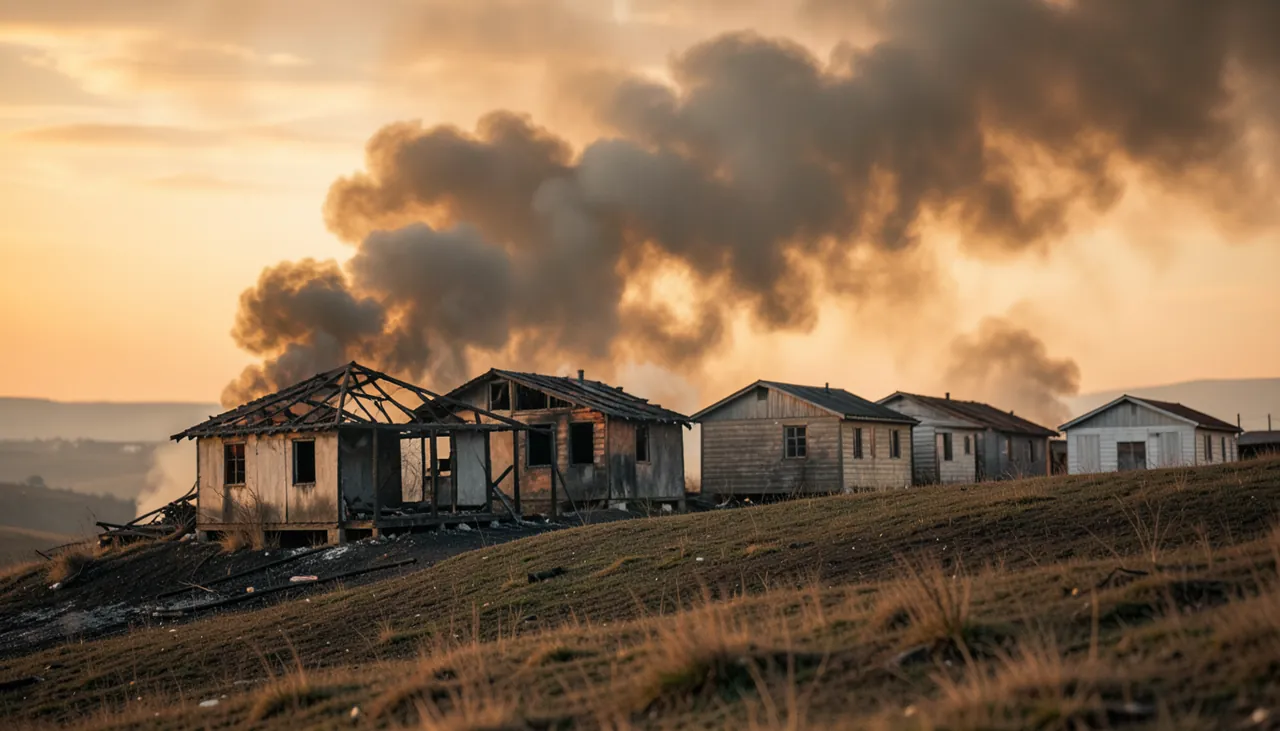
One wildfire season now equals 59% of everything Washington homeowners insurers paid on claims in 2025. David Forte, senior policy adviser at the Washington Office of the Insurance Commissioner, told Insurance Journal on November 12 that insurers anticipate $980 million of 2026 wildfire loss on roughly 3,500 claims. Statewide homeowners claims cost was $1.67 billion last year.
That figure covers every wildfire in the state from June onward. Most of it comes from the Spokane Complex, the Old Trails, Fairview and Autumn Lane fires that ignited on August 1, burned 19 days and destroyed about 900 structures. The Old Trails fire alone carries an estimated $665 million of insured loss and 615 destroyed structures.
In September the same office had put the season at $600 million. Before this year the state record was the $240 million paid on the 2023 Gray and Oregon Road fires. This site's week in review of August 10 noted the Spokane fires when early estimates ran in the hundreds of millions.
Key Takeaways
- The OIC's own projection for the season moved up by nearly two-thirds in two months: $980 million in November against $600 million in September.
- Old Trails is the costliest single fire in state history, at $665 million over 615 destroyed structures, or about $1.08 million per structure.
- The 2023 Spokane fires paid out far less per claim: $212.2 million across 664 paid claims, about $320,000 each, with 244 claims paid at the full dwelling limit.
- Cotality's insured loss range of $1.0 billion to $1.3 billion now sits just above the regulator's tally, after the September figure ran well below it.
- IBHS found only 13.8% of structures in the Old Trails perimeter within 10 feet of another, against 58% in the Eaton Fire, so spread ran through fences and mulch.
How the $980 million breaks down
September's $600 million projection carried roughly $535 million of residential loss, with the balance in commercial and auto. November's figure adds $380 million without a published split. Commissioner Patty Kuderer's emergency order of August 3, in force to September 30, required 45-day premium grace periods and stretched the property nonrenewal notice period from 60 to 120 days.
About 3,500 claims against $980 million is roughly $280,000 per claim statewide, below the 2023 average. That count includes smoke, partial-damage and auto claims from across the state. Cotality's property-level imagery of the Spokane fires found 5,256 damaged properties, 96% of them single-family homes, and classed 73% of the damaged homes as minor (Cotality, August 24, 2026).
Those damaged homes carry about $1.9 billion of reconstruction cost value, so the insured tally is about 52% of the mapped exposure. Cotality's own insured loss estimate, issued August 18 at $1 billion to $1.3 billion, now starts $20 million above the regulator's figure. Spokane County Assessor Tom Konis separately estimated rebuilding cost from the three fires at more than $1 billion (Insurance Journal, September 8, 2026).
| Measure | 2026 season | 2023 Gray and Oregon Road fires |
|---|---|---|
| Insured loss | $980M anticipated (OIC, November 2026) | $212.2M paid at July 31, 2024; $240M final (OIC) |
| Claims | About 3,500 statewide | 737 filed, 664 paid |
| Loss per claim | About $280,000 | About $320,000 per paid claim |
| Costliest fire | Old Trails: $665M, 615 structures destroyed | Gray and Oregon Road: 366 homes destroyed |
| Loss per destroyed structure, costliest fire | About $1.08M | Not published; 244 of 664 paid claims hit the dwelling limit |
| Share of prior-year statewide homeowners claims cost | 59% of 2025's $1.67B | Not published |
Computed from OIC figures reported by Insurance Journal (November 12, 2026) and the OIC's October 28, 2024 claim analysis. The 2023 per-claim figure is the OIC's; the 2026 per-claim and per-structure figures divide the reported totals.
The severity gap between 2023 and 2026
What changes a Washington wildfire cat load is the per-structure figure. $665 million over 615 destroyed structures is about $1.08 million each, more than three times the $320,000 the OIC reported per paid claim on the 2023 fires. Those are not the same unit: a paid claim can be a smoke or outbuilding loss, and the 2026 figure folds the fire's partial-damage claims into the 615 denominator.
Policy limits capped the 2023 figure, which is what the OIC's October 2024 claim analysis was about. Of 664 paid claims, 244 paid 100% of dwelling coverage, 75 of those without extended replacement cost, and 162 claims were still open at July 31, 2024 (Washington OIC, October 28, 2024). A severity assumption built on that experience measures what policies paid, and policies paid to their limits.
Cotality's perimeter data shows the gap from the other side. Its August 5 analysis counted 1,476 residential properties inside the Old Trails perimeter with $694.1 million of reconstruction cost value, about $470,000 each (Cotality, August 5, 2026). Insured loss of $665 million on that perimeter runs at 96% of the dwelling rebuild value of every home in it, destroyed or not. Contents, other structures, additional living expense and the commercial losses in the fire make up the difference between a $470,000 dwelling and a $1.08 million structure loss.
Washington homeowners claims cost $2.19 billion in 2024 and about $1.67 billion in 2025 (Insurance Journal, November 12, 2026). A season at $980 million is 45% of the first figure and 59% of the second. Five writers held 63% of 2025 direct premiums, according to AM Best data: State Farm 16.35%, Liberty Mutual 14.31%, Allstate 11.43%, Farmers 11.25% and USAA 10%. Their ZIP-level experience will surface in the NAIC's homeowners data call, which covers the territories their 2027 wildfire relativities are filed on.
Reinsurance towers move with the same anchor. A Washington property cat tower bought on 2023 experience was sized against a $240 million worst season; the 2026 season is four times that. AM Best's David Blades, associate director for industry research, said in August that primary insurers with concentrated portfolios "may re-examine their appetite for wildfire risk given how unpredictable they can be" (Reinsurance News, August 6, 2026). AM Best also noted Washington's FAIR plan can assess member insurers by premium share if losses run large enough. Kingstone, a Northeast regional writer, added wildfire cover to its 2026-2027 placement this year.
What IBHS found in the perimeter
The Insurance Institute for Business & Home Safety documented 132 structures across nine areas of the Old Trails perimeter and attributed spread to connective fuels, "particularly combustible fences and mulch," plus vulnerabilities in building materials, windows and decks (IBHS, October 2026). Only 13.8% of structures in the Old Trails perimeter had another structure within 10 feet, against 58% in the Eaton Fire, as Insurance Journal reported from the IBHS study.
For a wildfire model calibrated on the 2025 Los Angeles fires, the spread mechanism differs. At Old Trails it ran through wood fences, which carried flames between properties while vinyl fences melted. Mulch ignited framing beneath noncombustible siding where walls met foundations, and embers lit combustible material under decks. Forte cited "the Pacific Northwest love of mulch around the house" and said the findings reinforce a noncombustible zone of 0 to 5 feet around the home.
Forte's office is promoting IBHS's Wildfire Prepared Home standard as, in his words, "the pathway to a healthy insurance market in these high-risk areas." "The commissioner is taking the effort to try to educate everybody that we can't insurance our way out of this," he said. Any credit the office wants priced would discount a severity the 2023 data never showed, about $1.08 million per destroyed structure, on the strength of fence material and mulch placement.
Before the fires, the market had been settling. Cancellations and nonrenewals of Washington homeowners policies fell from 34,573 in 2024 to 29,081 in 2025, per the OIC's annual data call. A narrower OIC series, insurer-initiated nonrenewals for reasons other than nonpayment, rose 56% from 11,763 in 2021 to 18,372 in 2025 (KREM, August 12, 2026). Swiss Re's sigma series put wildfire losses on a 12% annual growth path. Verisk's 2026 modeled average annual loss benchmark was published before the Washington season entered any vendor's event set. No date has been given for a claim analysis of the 2026 fires; the 2023 analysis came 14 months after those fires.
Further Reading on actuary.info
- NAIC Data Call Brings ZIP-Level Scrutiny to Homeowners Rate Filings
- Verisk Raises Its Modeled Global Cat Loss Benchmark to $171 Billion
- Swiss Re Sigma Flags Wildfire as Fastest-Growing Peril at 12% a Year
- Kingstone Lifts Its CAT Limit to $500M and Adds Wildfire Cover
- Actuarial Week in Review for August 10 to August 14, 2026
Sources
- Washington Wildfire Claims Near $1B as Research Reveals Home Vulnerabilities (Insurance Journal, November 12, 2026)
- Insured Loss Estimates Top $600M From Washington Fires, Testing New Commissioner (Insurance Journal, September 8, 2026)
- Cotality Analysis: Spokane Wildfire Exposure and Damage Assessment (Cotality Hazard HQ, updated August 24, 2026)
- IBHS Post-Fire Investigation: 2026 Old Trails Fire Early Insights (Insurance Institute for Business & Home Safety, October 2026)
- Most Gray and Oregon Road Fire Survivors Were Under-Insured (Washington Office of the Insurance Commissioner, October 28, 2024)
- Kuderer Issues Emergency Order to Provide Relief to People Affected by Washington Wildfires (Washington OIC, August 3, 2026)
- AM Best Expects Considerable Insured Losses From Spokane-Area Wildfires (Reinsurance News, August 6, 2026)
- Washington Wildfires Destroy 700 Homes; AM Best Market Share Data (Beinsure, August 2026)
- Washington Wildfire Season Raises New Questions About Homeowners Insurance (KREM via Yahoo Finance, August 12, 2026)